National Guard (and Army Reserve) Essential in Europe

[Editor’s Note: Excerpt below From AUSA National]

For those of us who served in the National Guard or Army Reserve on training or on deployment in Europe or Asia, we know the value of the partnership with active duty units. It helps them with training, alleviates burdens when there are personnel shortages, and provides a level of comfort to leadership when regular rotations include known National Guard and Army Reserve units. The National Guard and Army Reserve Soldiers often provide continuity on scheduled training exercises. –Editor.

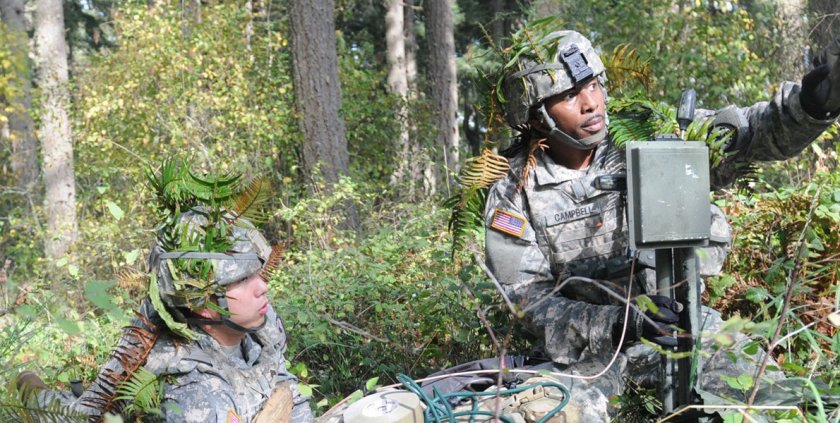
To make the fewer than 30,000 soldiers assigned to Europe look more like 300,000, U.S. Army Europe needs the Army National Guard and Army Reserve to train in the theater on a regular basis, the command’s top Guard leader says.

To that end, Army commanders in Europe are creating every possible training opportunity for Guard and Reserve troops, said Maj. Gen. John M. Gronski, who became U.S. Army Europe’s deputy commanding general for the Army National Guard on May 1.

Read more here.

More Cyber Please

Delaware has a long tradition of signal readiness. With cyber and electronic warfare capabilities being a top priority for the Army’s new cyber directorate, this bodes well for our first state Soldiers.

To that end, BG (P) Patricia Frost who heads the new cyber directorate, spoke recently at the two-day symposium “Mad Scientist 2016: The 2050 Cyber Army” held at the U.S. Military Academy. Her charge is to oversee electronic warfare and cybersecurity and to optimize exploits in the two arenas. The Army has fielded 41 of the 133 defense-wide teams that Congress has mandated be established by 2018. Frost believes, however, there are offensive and defensive gaps that will need to be filled at a tactical level.

For more on the story, check out AUSA’s post “Giving Field Commanders More Cyber Muscle

Cyber Warriors
photo by: US Army


Defense Spending Stalled Again

[Editor’s Note: From AUSA National]

It’s a 99.9% probability that Congress will pass a continuing resolution (CR) to keep the government running past the Oct. 1 deadline. How they reach their goal is the billion dollar question.

Any optimism the Senate had that they would be able to pass the defense spending bill was dashed Tuesday when the legislation failed to garner the 60 votes needed to proceed. This is the third time Democrats have blocked the measure.

Democrats are not necessarily opposed to the language in the bill, rather it is a tactical maneuver. They believe they will have more leverage over Republicans to secure additional domestic spending in the final FY17 spending package that presumably will be passed after the November elections.

There is nothing to suggest the path to passing a CR will be any easier.

The Senate leadership is in discussions with the minority leaders and the White House to move a continuing resolution to the floor next week. The stop-gap measure would expire Dec. 9.

There is some speculation that if the Senate can actually pass the measure next week, they would adjourn early, thus tying the House’s hands – either pass the Senate’s version or allow the government to shut-down, not a pleasing prospect any time much less in an election year.

House Republicans are divided on the duration of the measure with some agreeing to the shorter CR and, others, namely the House Freedom Caucus who do not favor lame-duck sessions and want the CR to last until March 2017.

Members of the House Freedom Caucus have indicated that they will support the short term continuing resolution if the leadership includes language dealing with Syrian refugees, an idea that will certainly be rejected by Democrats.

Round and round it goes!

AUSA prefers passage of routine spending bills in a timely manner. However, since that is unlikely, we strongly favor a short-term continuing resolution.

There hasn’t been a full year’s appropriation, adopted on time since 2007. While CRs are far better than government shut-downs, they are not a substitute for actual appropriations.

Under CR funding, the Army cannot move money around where it’s actually needed or start new contracts. Budget dollars are placed against needs and priorities of previous years, leaving the priorities and needs of the current year unfunded. The end result of all this is, at a minimum, things cost more and they take longer to get.

Congress is demanding that the Army spend less money but they are making it more difficult to achieve that goal. It’s no way to do business and unfortunately, we don’t see any return to regular order on the horizon.

Stay tuned.

Principles for Revitalizing American Leadership

The following article was published by AUSA.

A group of 29 distinguished defense and foreign policy experts gathered by the Association of the U.S. Army has produced a set of guiding principles intended to renew a sense of American identity in the United States, ensure a safe and prosperous future for its citizens, and provide focus for America’s role in the world.

Called “America’s Purpose: 21st Century Principles to Revitalize the American Identity,” the paper is the result of an effort launched last year by retired Army Gen. Gordon R. Sullivan, the former Army chief of staff who was AUSA’s president and CEO. Sullivan, who stepped down on June 30 as AUSA’s leader, viewed the project as an effort to create a document that would shape American policy, both domestic and foreign. The principles envisioned by Sullivan are not part of an international agreement, but are aimed at a domestic audience.

Historians, academics, defense and foreign policy experts, former diplomats, retired generals, and high-ranking executive branch leaders took part in discussions over several months that led to the final set of principles.

A preamble explains how the end of the Cold War and the singular focus on the former Soviet Union led to a loss of American identity and global focus.

“Since the end of the Cold War, the United States seems to have lost the centering mechanism that unified the nation. Without a clearly identifiable foe—the Soviet Union—the United States is facing a global landscape of foggy uncertainty, with occasional outbursts of destabilizing violence and dangerous regional instability,” it says. “It should not take a war for the United States to revitalize its sense of purpose and once again embrace its role as a world leader.”

“When America unites, its people win and the world is safer. ‘America’s Purpose’ provides a unifying framework to overcome domestic and foreign challenges, resulting in a safer, stronger America and a more stable and secure world.”

Key principles include a commitment to promoting world peace, advancing freedom and human rights for all people, promoting access to education, supporting legal immigration, and fostering cooperative global security.

Here is a link to the paper:
https://www.ausa.org/sites/default/files/publications/Americas_Purpose_131400Jul16.pdf

AUSA to host a Family Readiness forum in NJ

The Family Readiness Directorate of the Association of the U.S. Army has planned an event in September aimed at Army National Guard and Reserve families.

On Sept. 22, a forum focusing on National Guard and Army Reserve spouses will be held at the New Jersey National Guard Armory in Bordentown, N.J.

The forum for National Guard and Reserve spouses will look at help that is available for spouses and families when not located in a military community. The discussion will focus on where to find help, how to build a support network and practical tips.

Homefront United Network, an organization founded by Army National Guard spouse Angela Caban, is a co-sponsor of the event. Caban, the New Jersey National Guard Spouse of the Year 2013, and Bianca Strzalkowski, 2011 Military Spouse of the Year, will speak at the event.

Register for the Guard and Reserve spouse event here:

http://homefrontunited.com/spousetalks/

Army seeks Light Vehicle, Heavy Firepower

Representatives of about 60 companies took part in a Fort Benning, Ga., event to discuss the Army’s need for a new light infantry vehicle with heavy firepower. The Mobile Protected Firepower vehicle, MPF, could be based on a current vehicle that is either a light tank or a heavy troop carrier to cut down on the time it would take to be produced. Note: There is $10 million in the 2017 budget proposal for research and development of a vehicle that the Army hopes could start being built in 2018 if it takes only modifications in current platforms. Stay tuned for details …

Troop cuts represent “Unacceptable Risk”

A Senate Armed Services Airland Subcommittee hearing on Army modernization took a hard turn into the issue of personnel cuts amid growing global threats when LTG Herbert R. McMaster Jr. said plans to cut total Army end strength represent high risk—and quite possibly “unacceptable” risk.

“It’s an unacceptable risk because of a combination of factors,” said McMaster, deputy commanding general, Future forces, of the Army Training and Doctrine Command. “We all recognize that the threats to national and international security are increasing, and many of those threats are interconnected.”

Those threats include “revisionist powers” Russia and China, North Korea and Iran, in addition to the ongoing “transnational terrorist” threat, from ISIS, McMaster said. “As we look at the way threats to our national security are evolving, we need a joint force; that places a very high demand on ready land forces.”

He noted that current end strength plans would shrink the Regular Army to its smallest size since before World War II, at a time when the service has not been heavily modernizing weaponry and equipment. Previous drawdowns, such as after the Vietnam War and the Cold War, occurred after the Army had been “considerably” modernized, he said, and “we are not recently modernized.”

Sen. Tom Cotton, R-Ark., the subcommittee chairman, said lawmakers have discussed a larger active-duty Army—perhaps 480,000 to 490,000 soldiers, but he asked, “what would be the implications if Congress took that step but did not increase funding?” LTG Joe Anderson, Army Deputy Chief of Staff for operations and plans, answered, “The Army will never give up the readiness of its formations; so if you increase the number of soldiers” without an increase in the budget, modernization will take another hit. We can’t stretch out things more than we already have. It would make the problems we have right now even worse.”

DOD to VA Medical Care Transition

Last month the Defense and Veterans Affairs departments announced an ongoing effort to ease the transition for service members who require complex care management as they transition from the DoD system of health care to the VA.
The effort is designed to ease the burden for service members and veterans, who have suffered illnesses or injuries so severe as to require the expertise provided by multiple care specialties throughout both departments, officials said.”More than a decade of combat has placed enormous demands on a generation of service members [and] veterans – particularly those who have suffered wounds, injuries, or illnesses which require a complex plan of care,” said Dr. Karen Guice, principal deputy assistant secretary of defense for health affairs and co-chair of the DoD-VA Interagency Care Coordination Committee.
“These individuals require the complex coordination of medical and rehabilitative care, benefits and other services to successfully transition from active duty to veteran status and to optimally recover from their illnesses or injuries.””Our collaborative efforts with DoD have improved and enhanced the process of caring for our military members with serious illness, injuries or disabilities, as they recover and return to their communities,” said Dr. Linda Spoonster Schwartz, assistant secretary veterans affairs for policy and planning and co-chair of the DoD-VA committee. “Great attention has been made to develop a system which focuses on continuity of care, holistic support services and a ‘warm handoff’ for [service members and veterans] as they move from and between military, VA and community health care systems.

Message from AUSA National Headquarters

AUSA National Hqs recently shared an important message from General (R) Gordon Sullivan, President and CEO:

“I am more concerned about America’s Army today than any time since I first became a soldier in 1955. Our Army has a flat budget and continues to make force structure reductions while facing expanding global commitments, a combination that makes the goal of improving combat readiness dangerously out of reach. Instead, the Army faces a death spiral in which it consumes readiness faster than it can be restored, a situation that needs immediate attention from our nation’s political leaders.”

Secretary Carter speaks to “Boots on the Ground”

Defense Secretary Ashton Carter has again addressed the controversial issue of U.S. “boots on the ground” in Iraq and Syria, saying that more American troops would be deployed in an “enabling” role.
“Boots on the ground? We have 3,500 boots on the ground” in Iraq and “we’re looking for opportunities to do more,” Carter told CNN’s Fareed Zakaria.
Carter acknowledged there are about 50 U.S. Special Forces serving as advisers in Syria to local forces opposed to the regime of Syrian President Bashar al-Assad, in addition to the 3,500-3,600 American troops serving as trainers and advisors to the Iraqi Security Forces.
“We’re not looking to substitute for local forces in terms of governing and policing the place,” Carter said. “That’s why we put Special Forces in Syria. They’re tremendous force multipliers. They’re the ones who connect them to the great might of our military. The strategic concept is not to substitute but to enable” local forces, he said.
Carter also referred to the 1,300 soldiers from the 2nd Brigade Combat Team of the 101st Airborne Division out of Fort Campbell, Kentucky, who will deploy to Iraq this spring to replace troops from the 1st Brigade Combat Team of the 10th Mountain Division in the training role. The 1st BCT will return to Fort Drum, New York.
In his meetings last week in Switzerland and in Paris, Carter said that the number of U.S. and coalition troops in Iraq would “increase greatly as the momentum of the effort increases.”
Carter said the main focus would be on routing militants affiliated with the Islamic State in Iraq and Syria, or ISIS, from Mosul, the main stronghold of the insurgents in Iraq, and from Raqqa, the self-proclaimed ISIS capital in Syria.